|
Matsubayashi-ryu Karate-doOverview | O'Sensei Nagamine's own Words | O'Sensei Nagamine and Zen
| Matsubayashi-ryu Currently
Overview
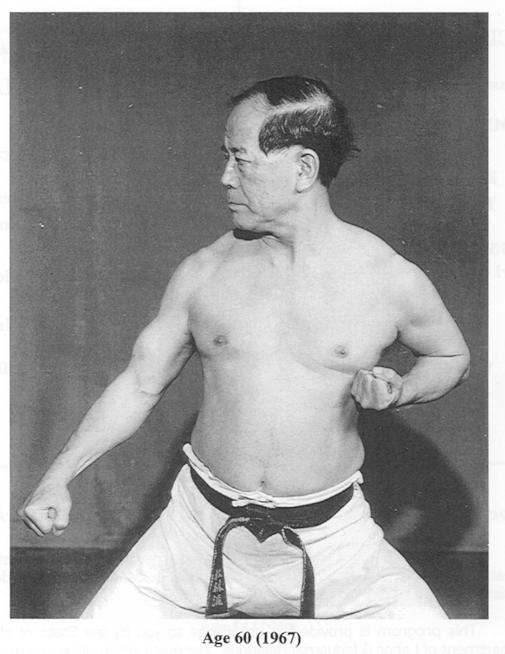
When Osensei (Grandmaster) Shoshin Nagamine (1907-1997)
opened his first Dojo in 1947 he named it the ‘Matsubayashi-ryu Kodokan
Karate And Kobujutsu Dojo’, and it was at this moment that
Matsubayashi-ryu was born.
Based on the teachings
of some of Karate’s legendary masters, including Arakaki, Kyan and
Motobu (whom Grandmaster Nagamine cites as his three primary
teachers), Matsubayashi-ryu though young in name, is ancient in
origin, with its roots going back centuries through the history of
Shorin-ryu and its constituent ‘styles’ of Shuri-te and
Tomari-te.
This ‘old style’
Karate of Okinawa has not lost its original values and intent – the
preservation of self, the development of righteous character and the
formation of an indomitable spirit, nor has it transformed itself
into a crowd pleasing competitive form, intent on creating athletes
for the purpose of winning medals. Instead, it has retained its
features of close quarter combat for personal protection, not
training to win medals, but to succeed in life.
According to Grandmaster Nagamine in his book, ‘The
Essence Of Okinawan Karate’, Matsubayashi-ryu – meaning the Pine
Forest School/Style – was named in honour of Grandmaster Nagamine’s
teachers, teachers – Kosaku Matsumora (teacher of Choki Motobu) and
Sokon Matsumura (teacher of Chotoku Kyan).
Matsubayashi-ryu can
also be pronounced Shorin-ryu; both are correct pronunciations,
though when differentiation is needed between Grandmaster Nagamine’s
teachings and that of another Shorin style, it is better to pronounce
it Matsubayashi-ryu.
This short piece is however, merely an introduction, and
for a clearer understanding of the history, and teachings of
Grandmaster Shoshin Nagamine, let us read his own words on the
matter.
From “Encounters with 'Ti' or 'Karate'” written by Grandmaster Nagamine
Introduction
On 15 July 1907, I was born in
Tomari-son, Naha City, of my father, Shoho and my mother Gozei. Though
my physique was rather small, I was active and aggressive as any other
healthy boys in my preschool days. Completing the compulsory education
of primary school in March 1923, I entered Naha City-run 5-year
Commercial School. However, when I was second-year student of the
school, I suffered from a gastroenteric disorder and given a medication
for some time. But, because of inefficacy of the medication, I had to
resort to a diet, while practising Karate at the backyard of neighbour
friend, Mr. Chojin Kuba. It was in 1926 and I was 17 years of age.
Though the hard work both at school and training of Karate, I succeeded
in recovering from illness, making me quite confident of good health.
When I reached the senior year, I had a chance to participate, as a
leader of Karate Club, in an annual martial arts demonstration of Kendo
and Karate among various schools. In those days, I began, earnestly;
work out every night at the ground of Tomari Primary School, under the
guidance of old master, Mr. Kodatsu Iha.
Ankichi Arakaki
After graduation in March, 1928, I
started a full-scale practice, becoming the disciple of Mr. Taro
Shimabokuro of Shuri City, who was senior of me by one year. It was my
daily task to cover 8 km road between Shuri and Naha on foot to master
the art of Karate. Thanks to the warm-hearted encouragement of brother
Taro, a hope was aroused in me, was enamoured with the charm of martial
art, and thus my appetite for Karate surpassed that of eating. Under
the guidance of another Sensei, Ankichi Arakaki, I made further
progress in the skills of Karate.
Recovery of health was complete then, I was 162 cm tall with
marvellously developed physique. In 1928, I was examined for
conscription, and passed it as class 'A' infantryman, and assigned to
the 47th Infantry Division stationed in Oita Prefecture, Japan. In
April of the same year, I was dispatched to skirmishes in Sainan,
China, and in July next year, returned to Okinawa after an honourable
discharge from the military service. Thinking about my future
profession in which I may be able to utilize the skills of Karate, I
decided it was policeman. And, in 1931, I was appointed a policeman of
Okinawa Prefecture. The notion that I should scientifically study
Okinawa Karate which, had never been systematically analysed in the
past, and the wishes for cultivating and training of body and mind
could never get out of my mind.
Chotoku Kyan
During my first assignment days at Kadena
Police Station, from December 1931 through August 1936, I was deeply
influenced by direct guidance of the most famous Sensei, Mr. Chotoku
Kyan who became my second teacher. In April 1936, I was sent to the
Tokyo Metropolitan Police Department, as a trainee policeman, and,
during a six-month period I had a chance to receive some advice about
peculiar Kumite movements from then celebrated master of Karate, Mr.
Choki Motobu in Hongo ward, Tokyo. After returning to Okinawa, I
continued to serve as a policeman of Okinawa Prefectural Police force.
Choki Motobu
On the recommendation of Sensei Chojun
Miyagi, founder of a different school called Goju-ryu, I was given a
title of Renshi in May 1940, from the Great Japan Botoku (Respect for
the martial arts) Association at the Butoku Festival held in Kyoto,
Japan. Realizing the existence of common essence between Kendo and
Karate, I began practising Kendo in 1938. After assiduous efforts made
for some time, I was awarded a Sandan in Kendo in 1941, and had an
opportunity to participate in the policemen's martial arts contest
among Kyukyu, Yamaguchi and Okinawa blocs which took place in Nagasaki
Prefecture. In December 1941, I was dispatched, as a trainee, to Police
University in Tokyo and, while I was there, given a chance to
demonstrate the police-Karateman's mysteries of Karate before a large
audience of policemen of the Metropolitan Police Special Guard
Division.
My duty as a chief of an Emergency Ration section of Naha Police
Station during the World War II days put me under very dangerous
situation in the fiercely fought battleground covering from Shuri to
Shimajiri village in southern part of the island. But, hearing the news
that defending Japanese Imperial Army Lieutenant General Ushijima
committed suicide on June 22, 1945, I realized the absurdity of
continuing fighting, so, with three fellow policemen in the same bunker
surrendered to the U.S. Armed Forces.
While engaged in the transportation of casualties in Iraha village with
other POWs, I happened to find on the road a book entitled
"Introduction to Karate" by Sensei Ginchin Funakoshi, by which I
determined to lead a life of Karateman and find a hope to struggle
against adversities. July 6, the same year, we the POWs were
transferred from Iraha to Kocha, Ginoza village for the cultivation of
the farm, while leading a life of refugees.
In the following December, I was appointed acting marshal of Taira
Police Station and in May the next year, Awarded a position of marshal
of Naha Police Office and moved there.
In July 1947, I was allocated a standardized house in Makishi ward,
Naha City, and after settling down for a while, a temporary dojo was
opened with the addition of wings to housing. The dojo was named
Matsubayashi-ryu Kodokan Karate and Ancient Martial Arts Study, where I
began practising and teaching Karate to youngsters. During the war,
Okinawa was a scene of carnage between the U.S. and Japanese forces,
eradicating distinctive culture, greenery of landscape, kind and
admirable characteristics of people, and an often referred to as 'the
Land of Courtesy' became the thing of the past. Young people lost their
spiritual guidance and fell into decadence; public morals corrupt,
moral decline caused an increase in the number of serious crimes.
A matter requiring immediate attention in such a situation was to
implant in the minds of youngsters an indomitable spirit. Though I felt
keenly the necessity of building an independent dojo where I may be
able to mingle with the young, practising together and sweating
together, but its realization was a remote possibility where there was
nothing but everything was reduced to ashes.
In the meantime, I was promoted to superintendent and chief of police
at Motobu District Police Station in January, 1951, and was busy
preparing for the All Ryukyu Judo Contest scheduled for October,
gathering all the young but white-belt policemen. Main purpose in the
training was to make progress in judo skills, but they were to work out
in Karate also. It was a very sad incident, however, when a policeman,
Siezen Ishikawa, was accidentally killed during practice. I still feel
bitter remorse about the mishap. Participants in the contest were from
such a large police stations as Maehara, Koza, Shuri and Naha, all of
these some 200-strong organizations, while our Motubu team had only 60
men, out of which 8 white belts took part in the competition.
Nonetheless, our team won the victory, beating all the 13 participating
stations. It was really a fruitful effort after so much workouts and
training. Our hard was finally paid off when all the members of our
team, including me, were promoted to black belts. When I decided to
quit after serving as superintendent for a year, however, fellow
policemen begged me to stay in my position. But, my strong
determination to follow a Karateman's life tore myself from my
policemen-friends with a bleeding heart. In January 1953, I managed to
build a long-cherished and full-scale Karate dojo for the first time in
Naha and restarted, hanging a shingle as "Matsubayashi-ryu Karate
Kodokan".
In the following December, I ran for election to the Naha City
municipal assemblymen and served for three terms and recommended for
vice chairman. I resigned the post in 1957. After that I had my dark
days following the failure in business twice, but even at the nadir of
my fortune, continued the practice of Karate. From time to time, I had
vague feeling of anxiety in tackling with Karate and my way of living.
Just then, I had a chance to read Book of Five Wheels written by
Miyamoto Musashi, in 1963, and was much moved. Already I had read
through a book titled "Teshhukoji-no-shinmenboku" (Buddhist layman and
master swordsman, Teshhu's true self). Luckily I was given a hint in
going ahead of my way as a Karateman through the reading. The two were
unrivalled swordsmen in all ages, had common in intelligence, bravery
and physical power, embraced the Buddhist faith so as to have an
unbending spirit, practised Zen meditation for art of war, and devoted
whole heart to the spiritual problems. These pioneers of martial arts
opened my eyes to re-orient my physically bent Karate to the
togetherness of Fists and Zen. So I was resolved to adopt Zen
meditation as part of Karate practice ever since.
O'Sensei Nagamine and Zen
As famous Zen Buddhist, Dogen once said,
"Accomplish what you cherish in your mind", I became, by a happy
chance, disciple of Zen priest, Sogen Sakiyama of Enkakuji in October
and began Zen meditation course within the dojo. As the priest went to
the U.S. for preaching, I begged teachings from Keisho Okamoto, another
priest of Rengein of Itoman, and furthermore from Shuzen Kise, priest
of Jushoin of Chatan for Zen practice.
Four classes of Karate are held daily in my dojo, during each class, a
15-minute Zazen (Zen meditation) is given for the strengthening of
minds and instilling philosophy of meaningless of surprise attack and,
not the defence but true sense of victory without fighting. Under the
conviction that togetherness of Zen and Karate is the one and only way
to master the real way of Karate, and hoping that many a young Karate
experts be nurtured, I am enjoying Karateman's life, with the spirit of
wholeheartedness
Grand Master Shoshin Nagamine Died in 1997. He left
Matsubayashi-ryu in the hands of his son, Soke Takayoshi Nagamine,
Hanshisei, 10th Dan.
Matsubayashi-ryu Currently
Upon the death of Grandmaster Shoshin
Nagamine, the supreme authority of Matsubayashi-ryu passed to his son,
Soke Takayoshi Nagamine. Soke Nagamine teaches at the Kodokan
Nagamine Dojo in Naha, Okinawa and oversees the development of
Matsubayashi-ryu through the representative sister organisations of the
World Matsubayashi-ryu Karate Association (WMKA, for the Americas) and
the European Matsubayashi-ryu Karate Association (EMKA).
Soke Nagamine has visited Europe many times, teaching seminars in
countries such as Norway, Germany, France and Ireland, and the numbers
of practitioners are growing all the time.
Soke Nagamine feels it the responsibility of every teacher of
Matsubayashi-ryu to retain the original form of every Kata (18 in
total) and Kumite Kata (7 in total) as handed down to us from
Grandmaster Nagamine. In this way, we are keeping alive the
tradition founded by Grandmaster Nagamine.
Though the Kata remain the same, Soke Nagamine also encourages personal
investigation into the meaning of the movements, the development of
personal knowledge and skill through the exploration of all possible
meanings of the techniques contained within the Kata.
Though the outside form doesn’t change the meanings are limitless.
A big Thank You to Martin O'Malley for this text!
|